
🧠What is AI? Simple Explanation for Beginners
📌Introduction
Artificial Intelligence (AI) is one of the most discussed technologies today. You may have heard about AI in the news, on social media, or while using apps on your phone. However, many beginners still feel confused about what AI really is and how it works.
In simple terms, AI is a technology that enables machines to think, learn, and make decisions like humans. It aims to solve problems, understand information, and improve over time.
Today, AI is present in many areas such as education, healthcare, entertainment, and business. From voice assistants to recommendation systems, AI is already part of our daily lives. In this article, you will learn everything about AI in a straightforward manner.
🤖What is Artificial Intelligence?
Artificial Intelligence, or AI, refers to machines or computer systems that can perform tasks typically requiring human intelligence. These tasks include learning, reasoning, problem-solving, and understanding language.
In simple words:
👉AI is a smart technology that helps machines behave like humans.
For example, when your phone suggests the next word while typing or when a video platform recommends content based on your interests, that is AI in action.
AI does not mean machines have real emotions or awareness. It simply means they are programmed to perform tasks intelligently by analyzing data.
🧠How Does AI Work?
AI works by using data and algorithms. It gathers information, studies patterns, and learns from experience. Over time, it gets better at making decisions.
A key concept in AI is Machine Learning, a method where machines learn from data without being programmed for every task.
Here’s a simple step-by-step process:
1. Data is collected (text, images, videos, etc.)
2. AI analyzes patterns in the data
3. It learns from mistakes
4. It improves its performance
For example, if you train an AI system to recognize cats in pictures, it will examine many images of cats and gradually learn how to identify them accurately.
📱Examples of AI in Daily Life
AI is not just a future technology—it is already part of your everyday life. Let’s look at some common examples:
1. Voice Assistants
Smart assistants like Google Assistant and Siri use AI to understand your voice and respond to commands. You can ask questions, set reminders, or control your phone with voice commands.
2. Chatbots and Writing Tools
AI chatbots like ChatGPT can answer questions, write content, and assist students in learning. Many people use these tools for studying, blogging, and work.
3. Social Media Platforms
Platforms like Instagram, YouTube, and Facebook use AI to show you content matching your interests. This is why you often see posts or videos that appeal to you.
4. Online Shopping
E-commerce websites use AI to recommend products based on your search and purchase history. This helps users find what they need quickly.
5. Navigation and Maps
Apps like Google Maps use AI to suggest the best routes, avoid traffic, and estimate travel time.
💡Types of AI
AI can be categorized into different types based on its abilities. Here are the main ones:
1. Narrow AI (Weak AI)
This is the most common type of AI today. It is designed to perform a specific task. Examples include voice assistants, recommendation systems, and chatbots.
2. General AI (Strong AI)
This type of AI would have the ability to think and learn like a human across multiple tasks. It is still being developed and does not fully exist yet.
3. Super AI
This is a theoretical idea where AI becomes more intelligent than humans. It is still a topic of research.
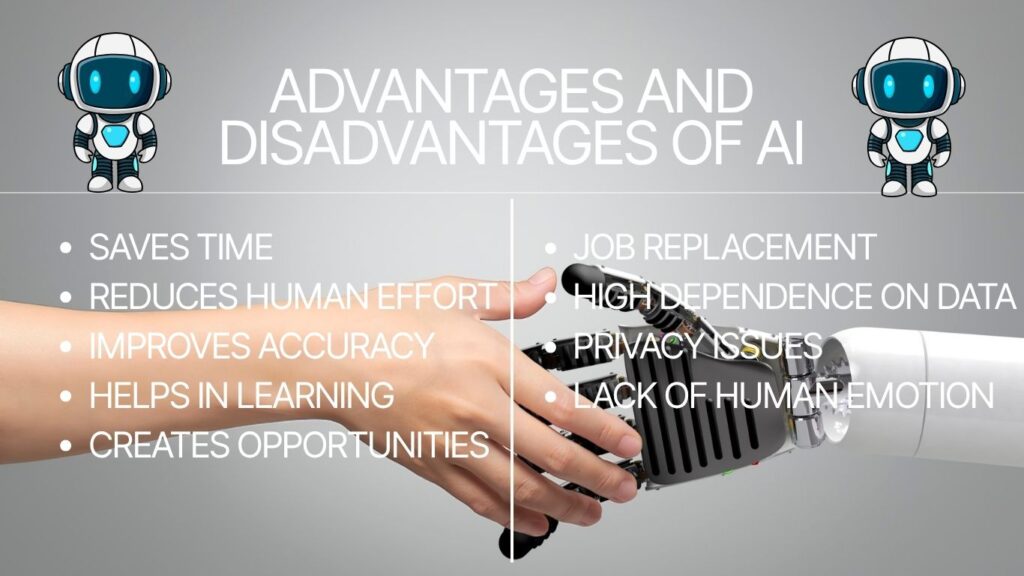
🚀Benefits of AI
AI has many advantages that make it useful in various fields:
1. Saves Time
AI can perform tasks quickly, reducing the time needed for work.
2. Reduces Human Effort
Automation helps people avoid repetitive and boring tasks.
3. Improves Accuracy
AI systems can analyze data very precisely, reducing errors.
4. Helps in Learning
Students can use AI tools to study, write assignments, and understand concepts better.
5. Creates Opportunities
AI has opened new career paths in technology, content creation, and freelancing.
⚠️Disadvantages of AI
Despite its benefits, AI also has some downsides:
1. Job Replacement
Some jobs may be taken over by machines and automation.
2. High Dependence on Data
AI systems rely on data. If the data is flawed, the results may also be incorrect.
3. Privacy Issues
AI systems collect and use personal data, which can raise privacy concerns.
4. Lack of Human Emotion
AI cannot truly understand human emotions or feelings.
🔮Future of AI
The future of AI looks very promising. It is expected to grow rapidly in the coming years.
In the future, AI may:
– Improve healthcare by helping doctors diagnose diseases
– Enhance education through smart learning tools
– Automate industries and increase productivity
– Help businesses make better decisions
AI will not completely replace humans, but it will change how we work and live. People who learn AI skills today will have better opportunities in the future.
🎯How Beginners Can Start Learning AI
If you are new to AI, you can start with easy steps:
1. Learn basic concepts of AI and Machine Learning
2. Use AI tools for daily tasks
3. Watch tutorials on YouTube
4. Practice using tools like ChatGPT
5. Read blogs and articles about AI
You don’t need coding skills at the beginning. Start small and improve step by step.
🏁Conclusion
Artificial Intelligence is a powerful technology that is changing the world. It helps machines perform tasks intelligently and makes our lives easier. From smartphones to online platforms, AI is everywhere.
For beginners, understanding AI is the first step toward future opportunities. By learning how AI works and using it in daily life, you can build your skills and even find new ways to earn money.
👉AI is not just the future—it is the present. Start learning today and stay ahead in the digital world.